TITAN aquires SNe Ia photometry on the ATLAS (Asteroid Terrestrial Last Alert System) telescope network. ATLAS is comprised of four telescopes, two in Hawaii, one in South Africa, one in Chile, covering an all sky region, with data spanning a decade. Unlike DECam or Pan-STARRS, ATLAS uses two broadband filters, cyan and orange. Additionally, the CCD cameras in the four telescopes have been swtiched out multiple times resulting in 9 total CCDs over the lifetime of the network. The vast scale of the ATLAS network, which enables the large datasample of TITAN, requires precise calibration and systematics estimation.
What is TITAN?
TITAN - the Type Ia Supernova Trove from ATLAS in the Nearby Universe - is a new low-redshift Type Ia supernova (SN Ia) sample built for the era of precision cosmology.
Using the all-sky ATLAS survey, TITAN brings together:
- Cosmology-grade, uniformly calibrated SN Ia lightcurves
- A large, homogeneous nearby sample of >5000 spectroscopically confirmed SNe Ia at z ≲ 0.1
- A matched host-galaxy catalogue with redshifts and derived physical properties
TITAN is designed both as a modern replacement for heterogeneous legacy low-z samples and as a laboratory for understanding host-galaxy systematics, such as the SN Ia “mass step”.
The first data release of TITAN will consist of 4 papers detailing the construction of various aspects of the sample. These papers are:
- Calibration
- Lightcurve fitting
- Simulations and bias corrections
- Host galaxy associations and properties
Click the above links to read a short summary of each aspect of TITAN DR1.
Why do we need a new low-z SN Ia sample?
Recent cosmological analyses that combine SN Ia Hubble diagrams with BAO and other probes are starting to show hints of tension with the standard ΛCDM model and possible signatures of evolving dark energy. The statistical power of these experiments has outgrown the nearby SN Ia data they rely on.
Most existing low-z SN Ia samples:
- Were assembled from many different surveys with differing selection functions
- Use older photometric calibrations
- Have incomplete or inhomogeneous host-galaxy information
As a result, calibration, selection effects and host-related systematics now limit SN Ia cosmology, rather than raw statistics. TITAN aims to provide a single, homogeneous, well-characterised low-z anchor that is commensurate with the precision of Stage IV dark-energy experiments.
Another key motivation for TITAN is the host-galaxy “mass step”: an empirical offset in SN Ia Hubble residuals between supernovae in low-mass and high-mass galaxies. This effect is one of the dominant systematics in current SN Ia cosmology, but its physical origin - progenitor age, metallicity, star-formation history, dust, or some combination - remains unclear.
TITAN provides:
- Robust SN-host associations
- Spectroscopic host redshifts compiled from public catalogues
- Multi-band host photometry with SED fitting to estimate stellar mass, star-formation rate, dust attenuation and structural indicators
The size and homogeneity of the TITAN sample allow us to move beyond a single “mass step” parameter and to explore how SN Ia luminosities vary across a richer space of host properties. TITAN is intended both to clarify the root cause of the mass step and to identify host-dependent corrections based on observables measurable across the full redshift range, so they can be applied consistently to all cosmological SNe Ia.
Calibration
For our calibration of ATLAS for use in cosmology we calibrate first at a multi-pixel level, observing deviations within each individual CCD filter combination (intra-chip). Second, we cross calibrate each CCD with DES (Dark Energy Survey) year 6 data release, to provide a relative calibration of ATLAS with a well measured survey that contains stars across a declination range that contains both northern and southern telescopes and data inside and outside the PS1 region, since PS1 is the primary initial calibration instroment of ATLAS through the Refcat2 catalog. For this aspect of calibration we produce inter-chip offsets between the CCDs and provide a correction for an observed chromatic slope in serveral of the CCDs.
After our calibration is complete we validate our calibration. We first examine the effect our calibration has on an independent set of tertiary stars that are not found in the Refcat2 survey. Second, we examine primary HST (Hubble Space Telescope) CALSPEC standard stars that validate our results tied to an absolute flux scale. Finally, we examine that after calibration, we find no systematic offset between TITAN and other premier low-z SNe Ia surveys.
Lightcurve fitting
Simulations and bias corrections
To understand what ATLAS would see for a given underlying SN Ia population, we build forward simulations of the survey. Using the real ATLAS cadence, depth and image quality as input to SNANA, we generate synthetic SNe Ia, run them through the same detection and lightcurve fitting pipeline as the data, and then adjust our noise and selection models until the simulated light curves and fitted parameters closely match those of real TITAN SNe.
Once validated, these simulations become the engine for our bias and completeness work. They let us quantify how detection and spectroscopic follow-up shape the observed sample, estimate Malmquist and standardisation biases in the Hubble diagram, and derive the bias corrections needed to use TITAN as a precision low-z anchor for cosmology. This work will be published in a forthcoming paper by Tweddle et al.
Host galaxy associations and properties
To characterise the environments of TITAN SNe Ia, we first build a robust catalogue of host galaxies. We combine several complementary host-association methods (including manually vetted ATLAS hosts, DLR-based matching and probabilistic cross-matching codes) to choose the most likely galaxy for each supernova and to compile the best available redshift. We then use the HostPhot pipeline to obtain consistent, aperture-matched photometry from the far-ultraviolet to the mid-infrared, and fit these spectral energy distributions with modern SED-fitting tools to infer global stellar masses, star-formation rates and dust content. This provides a homogeneous set of host properties for the entire TITAN sample.
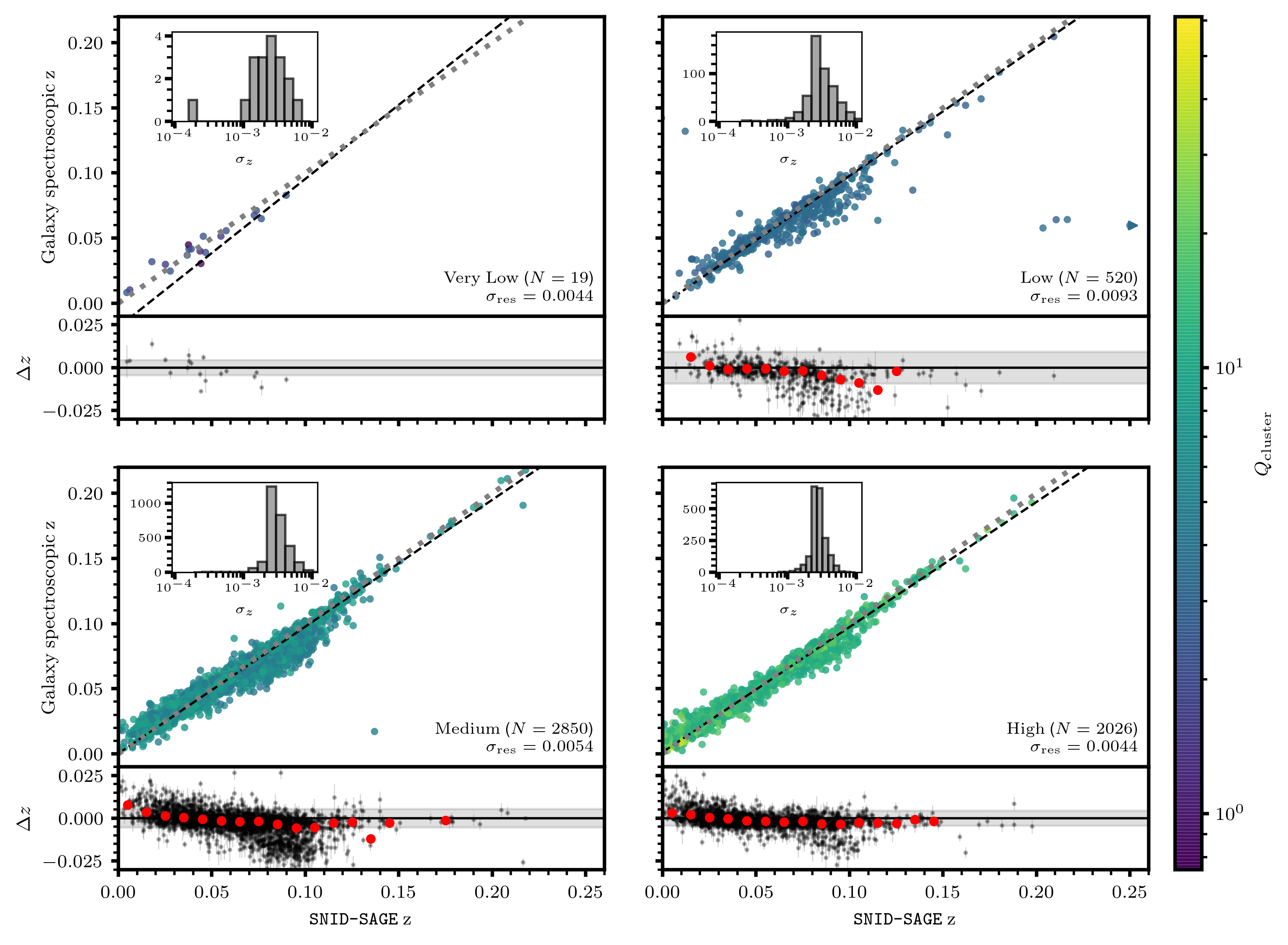
We assess the quality of the host-galaxy spectroscopic redshifts, and compare them to those derived from SN spectra, finding overall strong agreement. We also test the reliability of our host properties in several ways. We directly compare HostPhot fluxes to external catalogues such as SDSS, finding excellent agreement, repeat SED fitting while selectively removing UV and IR bands to assess how the available wavelength coverage affects the inferred properties, and compare the properties of TITAN host galaxies to those of other SN samples. The work of compiling the host catalogue will be released in a forthcoming paper by Tweddle et al., and an astrophysical and cosmological analysis of TITAN SNe and their relation to their host galaxies will be addressed in future work.